
What is a hero?
On The Death of Robin Hood

June has been an eventful month! The Traitor of Sherwood Forest was featured on the BBC alongside Michael Sarnoski’s new film, The Death of Robin Hood. Traitor is also a finalist for the Star Award, and two new translations of the book, in Russian and Hungarian, are now on sale. More on all this in the news section!

It was amazing to see Traitor in conversation with the latest Robin Hood movie. At first glance, The Traitor of Sherwood Forest and The Death of Robin Hood are very different. My book stays close to the medieval ballads, while Sarnoski’s film is intimate, psychological, inspired by the poem “The Death of Robin Hood”—and also clearly informed by Walter Bower’s chronicle, which describes Robin as a “famous murderer.” My Robin Hood is a hero whose flaws lead to a tragic fall; the film’s Robin is a cutthroat from the beginning, and his legends are mostly lies.1 But I do feel like we’re asking similar questions about heroism, about masculinity and violence, and about just how skewed our view of the past really is.
Heroes Medieval and Modern
It can be hard for a modern audience to process the duality of medieval heroes because they’re so often what we would call “grey characters” today. The number of people who have read my Robin Hood as a villain rather than a flawed and tragic hero has surprised me. But it shouldn’t have, because I know there’s a huge difference between the medieval idea of a hero and the modern one.
Heroes in medieval literature can do monstrous things. King Arthur murders a whole bunch of children because of a prophecy. Gawain beheads a damsel who is trying to save her knight. Siegfried participates in Brünhild’s rape. Even our beloved Robin Hood—who is a hero in the medieval ballads, who is kind and courteous and rescues people—can also be monstrous, and so can his Merry Men. Robin strikes Little John for besting him in an archery game, the Merry Men murder a monk and his ‘litull page,’ and Robin disfigures Guy of Gisbourne and then sticks Guy’s severed head on the end of his bow.
What’s the point of having heroes like this? It’s hard to wrap our minds around them in an era when people one-star books for protagonists doing things they disagree with.
But medieval heroes aren’t there to be role models or perfect, virtuous people to emulate. Their acts of greatness are meant to inspire us, and their acts of destruction are meant to warn us. Flawed heroes teach us about being human—not just through their successes and their acts of bravery, but through their weaknesses, and even their atrocities.
In medieval literature, those atrocities almost always have consequences. Medieval ballads and poems are full of violence, but that violence is not taken for granted. It’s seen as the tragedy it really is. Each time a senseless death occurs, the poet mourns. Each time, the poem laments that there must be a better way.
And in The Death of Robin Hood, this mourning, this lament, and the duality of medieval heroes are woven throughout the film in really fascinating ways.
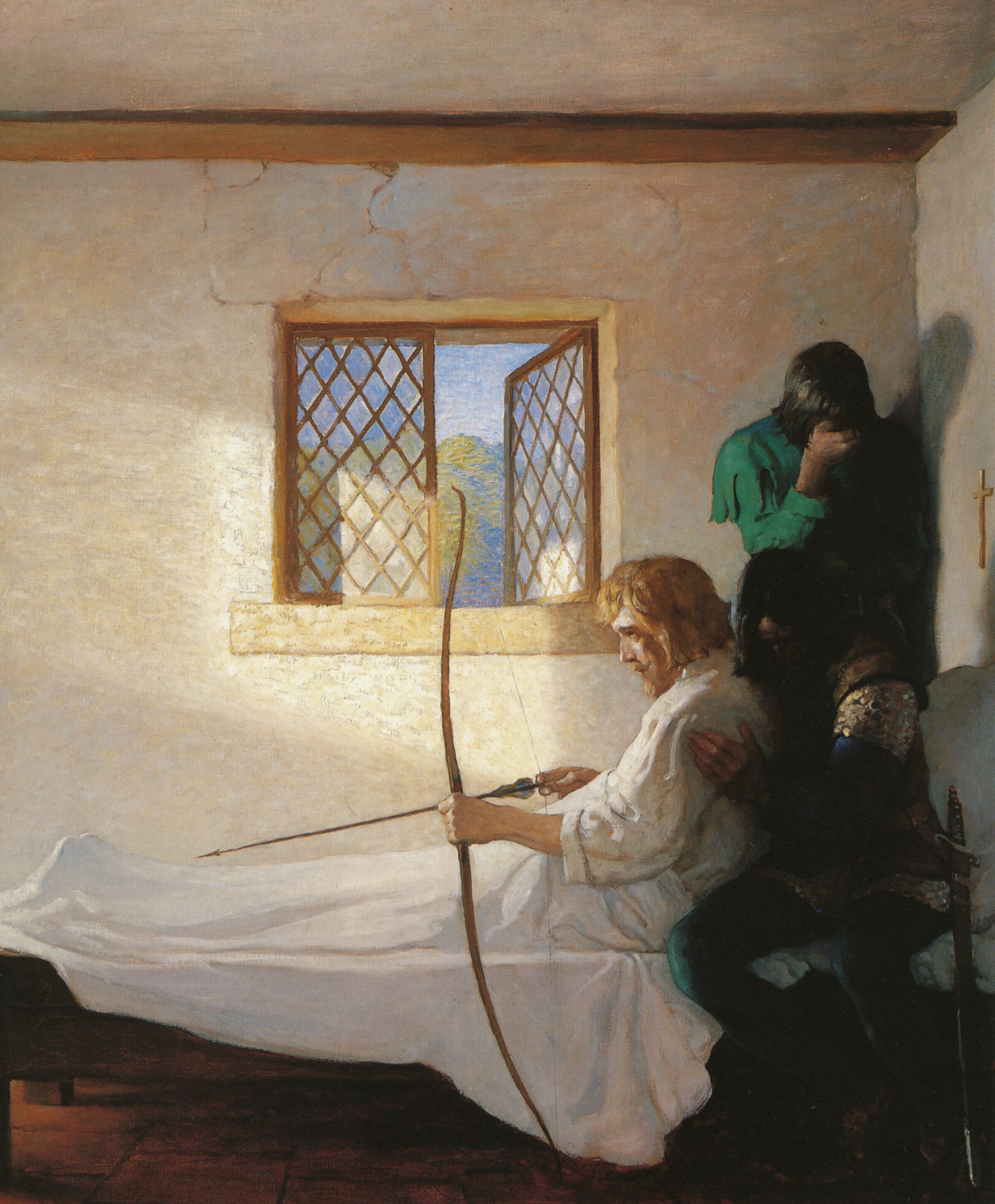
Gender and Medievalism
If you know my scholarship, you’ll know I love talking about gender and medievalism. And I think the film is doing something clever around this: manipulating medievalism to make a point about masculinity and violence.
When we meet Robin in The Death of Robin Hood, he might as well have stepped out of Game of Thrones. He wanders through a landscape full of blowing snow, vast, empty hills, desolate and infertile. All the tropes you expect from a brutal, masculinist view of the Middle Ages are there: Vikings (Little John claims to be descended from them), blood debts, giant boars, and of course, gory battles. Robin’s acts of violence are grotesque. He believes in nothing. His world and his world view are futile, faithless, and cynical, his path one of murder and destruction.
There’s a lot that seems to be missing from this version of Robin Hood: humour, generosity, courtesy, care, and even his legendary faith in the Virgin Mary. But we find all this in an unexpected place, on an island of healing reminiscent of the legendary Avalon, where the prioress Brigid, played by Jodie Comer—who has brilliantly mastered medieval cadence—has her own little kingdom, which she governs with hope, faith, philosophy, and science.
(Surely, the reference to the goddess Brigid is intentional here. She is, after all, a goddess of wisdom and healing.)
When Robin Hood awakens, wounded, in Brigid’s priory, the entire medieval landscape has changed. He walks through softly-lit, womblike corridors to find a thriving community full of gardens, trees, and children. It is a place of healing, but also of intellect and wisdom. A leper speaks to Robin Hood about Boethius. Brigid herself is swept up in Lucretius and his theory of atoms. She challenges Robin’s whole notion of reality, arguing with him at every turn that the world is full of beauty, of possibility.
The film does a lot of visual storytelling, and the contrast between Robin’s medieval world and Brigid’s couldn’t be more clear. Robin is living in the mythical Middle Ages—the one so often championed by the manosphere, by patriarchal institutions, by warmongers whose stories can, as Robin says, “make men do terrible things.” And Robin Hood constantly tells us that this version of the Middle Ages runs on lies.
But Brigid is living in the human Middle Ages, the one full of light and community, philosophy, theology, and the hope that helps us survive sorrow and suffering. You know—the real one.
The Power of The Past
The Death of Robin Hood has echoes of David Lowery’s The Green Knight, and I don’t think it’s a coincidence that we’ve had two big medieval movies recently about the absurdity and hollowness of violence. Our world is just as entangled in violence as the Middle Ages were, and on a larger scale. In an age of global conflict, nobody’s hands are clean.
“Is this our past as well as our present?” these movies seem to ask us. “Is violence our only destiny?” In The Death of Robin Hood, at least, the answer is no. Both the viewer and Robin learn that the past is a full cup, if we’re willing to drink deeply. The film presents us with a choice about what we take from history and legend. But that choice requires a sacrifice. And our ideas about what heroism is, and what it isn’t, are on the chopping block.
Because ultimately, the prioress is the hero of The Death of Robin Hood. She is the one who embodies generosity, who defends and cares for the people who can’t stand up for themselves. Not everyone will be comfortable with that severing of Robin’s image, splitting off his virtues and leaving only his shadows. But those willing to suspend their ideas about a legendary hero, even just for the two-hour film, might have to consider whether or not the spirit of Robin Hood can carry on without the man.
News and Updates
I was so grateful to be interviewed about The Traitor of Sherwood Forest by Caryn James for the BBC, who wrote a really insightful piece on the darker turn in Robin Hood retellings. If you’re planning to see The Death of Robin Hood, it’s a must-read.
Both the Russian and Hungarian editions of The Traitor of Sherwood Forest are out now! The Hungarian edition has gorgeous sprayed edges, and I’m pretty keen on the Russian title: Betrayal in Sherwood Forest. (Why didn’t I think of that?)
Traitor has been named a finalist for the WFWA Star Award in the debut category! The winner will be announced in the fall.
Finally, in very sad Robin Hood news, the Major Oak famous to Robin’s legend, which has been ailing for years, has died. I described the tree in The Traitor of Sherwood Forest, so I’ll leave you with those lines. As with all mythic and legendary things, our stories are the way it will live on.
A massive oak held court in the forest’s center, thick and strong. Seashells danced on ropes throughout the oak’s branches, tangled white and gray and pink among the crisping leaves. The shells sang like tiny church bells when the wind swept through.
—Amy
The film hints that Robin has forgotten pieces of his own legend, but I won’t give away too many spoilers.